
Review · VESPA TOURS
Exploring Rome on a Vintage Vespa Adventure Journey
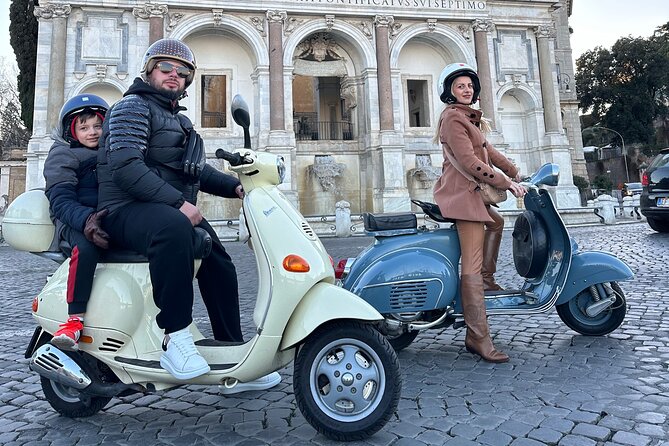
Rome makes the most sense from the back of a classic Vespa. You can slip through narrow streets, cross from the Pantheon to Trastevere, and cover a lot more ground than you could on foot in three hours. Guide Erion brings the city to life with local stories, favorite corners, and a clear love for Rome.
I like the mix of major sights and less expected stops, especially the views from Janiculum Hill and the chance to reach places such as the Pyramid of Cestius. I also like that snacks and a soft drink are included, so the tour gives you a small taste of Roman life instead of only a fast ride past monuments.
The main consideration is the pace. You get many short stops, not long visits inside the sights, and admission is not included. If you want detailed time at the Colosseum or Pantheon, book a separate walking visit.
Key points to know before booking
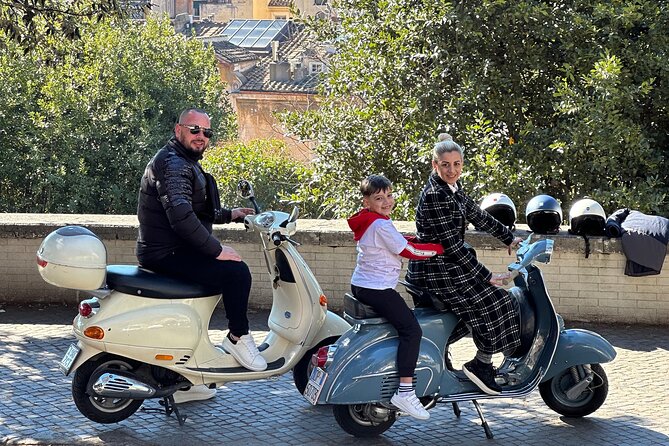
- Classic Vespa access: A scooter is well suited to Rome’s tight streets and lets you cover a wide stretch of the city.
- Erion’s local focus: Guide Erion adds stories, viewpoints, and lesser-known places to the standard monuments.
- Major sights in three hours: The route includes the Pantheon, Piazza Navona, Trevi Fountain, Spanish Steps, St. Peter’s Basilica, and the Colosseum.
- More than the usual center: You also reach the Pyramid of Cestius, Circus Maximus, Janiculum Hill, and Trastevere.
- Private experience: Only your group takes part, with live guidance available in English, Spanish, or Italian.
- Weather matters: The tour can be moved or refunded if poor weather prevents the ride.
Why a Vespa works so well in Rome
Rome is not a tidy museum laid out for easy walking. Its sights spread across hills, riverbanks, grand avenues, small lanes, and crowded squares. A Vespa gives the route a useful middle ground. You are close to the street and able to reach places a larger vehicle cannot, but you do not spend the whole day walking between distant monuments.
That matters on a three-hour tour. The route moves from the historic center to the Spanish Steps, across to the Pyramid of Cestius, up to Janiculum Hill, through Trastevere, and back toward the Vatican and Colosseum. On foot, that would be a demanding day. By Vespa, it becomes a quick survey of Rome’s different moods.
The ride is not just transportation. It changes how you notice the city. You see the narrow lanes, stone façades, busy piazzas, and sudden views as part of one connected place. Erion’s live commentary helps give those sights a thread, instead of leaving you to collect disconnected photographs.
Because this is a private activity, you do not have to match the pace of a large group. That is useful if you want to pause for a picture or ask about a particular monument. Still, the number of stops means each one is brief. Think of the experience as a moving introduction to Rome, not a substitute for museum visits.
More Vespa Tours in Italy
- Vespa Sidecar Tour By Night with Pickup
★ 5.0 · 1,803 reviews - Rome Morning Vespa Sidecar Tour in Rome with Cappuccino
★ 5.0 · 1,771 reviews - Rome: Explore the City by Vespa with an Optional Photoshoot
★ 5.0 · 1,103 reviews
From Piazza di Pasquino to the Pantheon
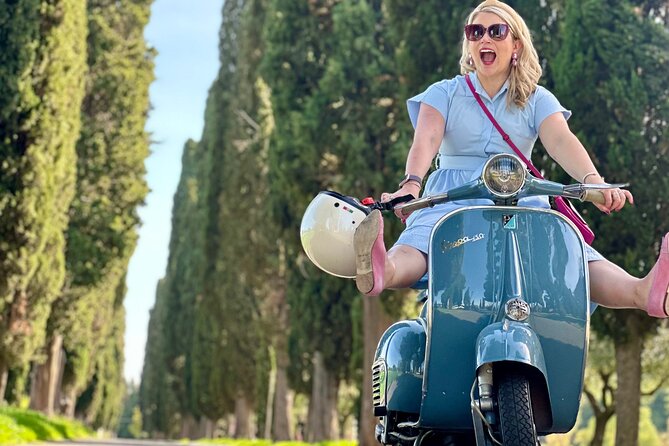
The tour begins at Piazza di Pasquino, a central meeting point near Rome’s historic core. From there, the first major stop is the Pantheon, one of the best-preserved buildings from ancient Rome.
The Pantheon was completed in AD 126 and began as a Roman temple. Its most memorable feature is the oculus, the round opening in the dome that brings in natural light. A 20-minute stop gives you time to look at the exterior and, if conditions allow, take in the building’s scale without rushing past it.
The practical point is that the admission ticket is not included. The stop is still worthwhile from outside, since the building’s enormous portico and unusual dome are easy to appreciate from the piazza. If entering the Pantheon is important to you, confirm the current entry arrangements before the tour and allow for the fact that this Vespa experience does not provide a dedicated interior visit.
Piazza del Popolo and Piazza Navona
Piazza del Popolo is a broad urban square at the northern end of the central city. Its name means People’s Square in modern Italian, though its older connection is to poplar trees and the church of Santa Maria del Popolo.
The stop lasts about 10 minutes, so expect a quick look rather than a long visit to the church or surrounding streets. The square gives you a useful sense of Rome’s grand urban planning, with a wide open space that contrasts with the lanes you pass through by scooter.
Piazza Navona gets more time, about 20 minutes. The square follows the shape of the ancient Stadium of Domitian, built in AD 85 and once able to hold about 30,000 spectators. Today, it is one of Rome’s most recognizable public spaces, but the older stadium remains part of its shape and story.
I like the pairing of these two squares because they show different sides of Rome. Piazza del Popolo feels spacious and formal. Piazza Navona feels more layered, with ancient foundations beneath a later city. You get enough time to orient yourself, hear the story, and take photographs, but not enough for a leisurely café stop.
Trevi Fountain, Campo de’ Fiori, and the Spanish Steps
The Trevi Fountain receives a 15-minute stop. Designed by Nicola Salvi and completed by Giuseppe Pannini in 1762, it is about 26 meters high and 49 meters wide. Those figures help explain why the fountain can feel enormous even when the surrounding streets are tight.
This is one of the busiest points on the route, and the short stop is realistic. You can see the Baroque design, take pictures, and listen to Erion’s explanation, but you should not expect quiet reflection. Keep your belongings secure and stay aware of the meeting time, since the tour continues on schedule.
Campo de’ Fiori offers a different kind of Roman scene. Its wooden market stalls sell flowers, fruit, meat, and fish, while the square also carries a darker memory. Giordano Bruno was executed here in 1600 after being accused of heresy, and his statue marks that part of the square’s past.
The 15-minute visit lets you take in both sides of the place: the everyday market and the difficult history. Market activity can vary by time and day, so do not book this tour solely for a particular stall or product. The value is the quick local context, not a full food tour.
The stop at Piazza di Spagna also lasts 15 minutes. The Spanish Steps climb from Piazza di Spagna to the Trinità dei Monti church above. The stairway has 135 steps and connects the lower square with one of Rome’s best-known elevated views.
The Vespa gets you close, but the tour is not designed for climbing and lingering on the steps. You will have time to see the setting and hear why the staircase links French royal patronage, the church, and the Spanish Embassy nearby. Wear comfortable shoes if you plan to walk around during the stops.
More Vespa Tours in Rome
- Rome Vespa Scooter Tour with Professional Photographer
★ 5.0 · 857 reviews - Rome: Highlights Vespa Sidecar Tour with Coffee and Gelato
★ 4.9 · 747 reviews - Rome: Vespa Ride with Pictures and Sweet Tastings
★ 5.0 · 723 reviews - Rome Afternoon Sightseeing Vespa Sidecar Tour with Gourmet Gelato
★ 5.0 · 692 reviews
The Pyramid of Cestius and Circus Maximus
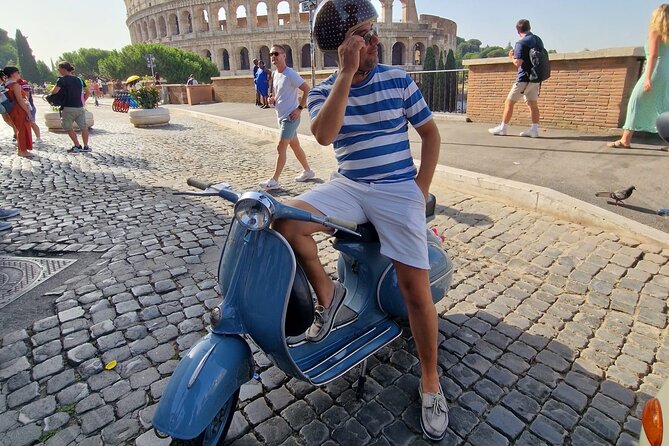
The Pyramid of Cestius is one of the route’s most surprising sights. Built as a tomb for Gaius Cestius, it was modeled in the style of Nubian pyramids and later incorporated into Rome’s fortifications. That helped preserve it, making it one of the city’s best-kept ancient structures.
The 15-minute stop works well because the pyramid is mainly an exterior sight. It also takes you away from the most familiar tourist circuit. If you have already seen the central piazzas, this is one of the places that makes the tour feel more distinctive.
Next comes Circus Maximus, the ancient chariot-racing stadium between the Aventine and Palatine hills. It once measured about 621 meters long and 118 meters wide and could hold more than 150,000 spectators. Today the site is a public park used for events and festivals.
Ten minutes is enough to grasp the enormous footprint, though not enough to explore the area in detail. The open space can be hard to read at first because much of the ancient structure is no longer intact. Erion’s explanation matters here, helping you picture the scale of the arena rather than simply seeing a broad field.
Janiculum Hill and the view across Rome
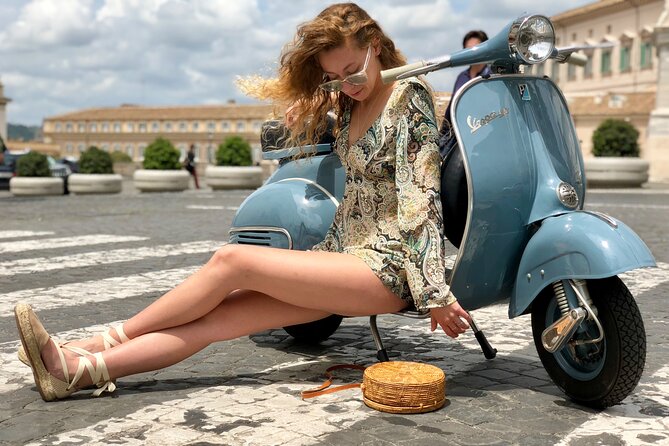
Janiculum Hill is one of the strongest parts of the route for anyone who wants a wide view of Rome. It sits west of the Tiber and is not one of the ancient Seven Hills, but it gives you a useful look across the city.
The stop lasts about 20 minutes, longer than several central squares. That extra time lets you pause, take photographs, and absorb the change from enclosed streets to an open viewpoint. The hill also has the Fontana dell’Acqua Paola, a Baroque fountain built under Pope Paul V in the late 17th century.
This is where the Vespa format pays off most clearly. A climb that would take effort on foot becomes part of a larger city route. You get one of the better chances during the tour to slow down and see Rome as a whole, not just as a series of monuments.
Trastevere’s old lanes
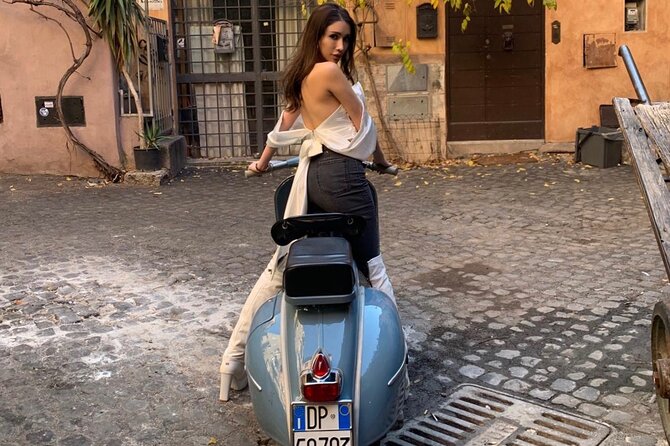
From Janiculum Hill, the route reaches Trastevere, the district across the Tiber. Its name refers to its position on the other side of the river, and its narrow cobbled streets and old houses still give it a distinct feel.
Rome once had limited connections to this side of the river. The Pons Sublicius, a small wooden bridge, was the early link between Trastevere and the rest of the city. Today, the area is known for pubs and restaurants, but its older street pattern remains part of its appeal.
The Vespa is especially useful here. Narrow lanes are one of the reasons to choose this experience over a standard vehicle tour. You can pass through parts of the district that feel more personal and less monumental, while Erion explains what you are seeing in real time.
The route does not promise a full meal in Trastevere. Dinner is not included, and the tour lasts only about three hours. Instead, you receive snacks and a soft drink, which make a practical light refreshment during the ride.
St. Peter’s Square and the Vatican setting
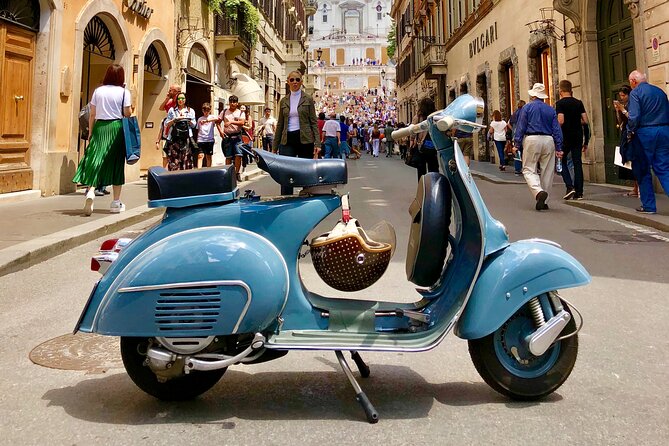
The stop at St. Peter’s Basilica focuses on St. Peter’s Square, the great plaza in front of the basilica. The square is in Vatican City and is framed by Gian Lorenzo Bernini’s massive Doric colonnades, which are four columns deep.
At its center is an ancient Egyptian obelisk placed there in 1586. Bernini’s fountain from 1675 matches an earlier fountain by Carlo Maderno. These details are easy to miss when you are focused only on the basilica’s façade, so a guide’s explanation adds real value.
The scheduled visit lasts about 15 minutes. This is enough to see the square and understand its design, but it is not a basilica interior tour and does not include Vatican admission. If the Vatican is your main reason for visiting Rome, treat this stop as an introduction and plan a separate visit with the time and ticket required.
The Colosseum as the final major sight
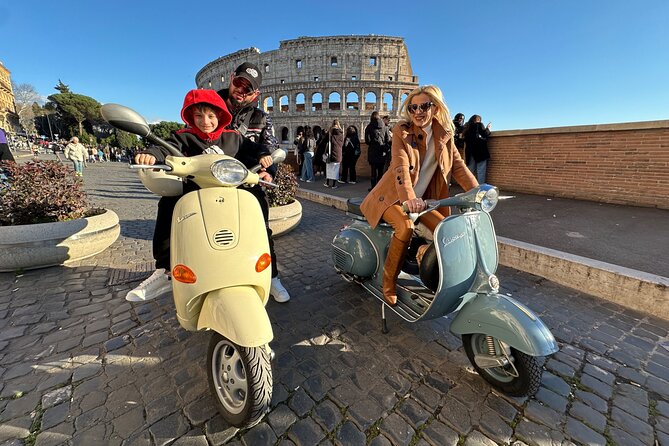
The Colosseum is the last major monument on the route. Construction began under Emperor Vespasian in AD 72 and was completed under Titus in AD 80, with later changes under Domitian. The three emperors belonged to the Flavian dynasty, which explains the ancient name Flavian Amphitheatre.
The building remains the largest ancient amphitheater ever built and the largest still standing. A 20-minute stop gives you time to take in its exterior and hear the basic story of the arena, but it does not include entry.
That limitation is important. The Colosseum needs time, and the interior route involves several levels and exhibits. This tour gives you a strong first look and helps you place it within the wider city, but you should not expect the depth of a dedicated archaeological tour.
Price, private format, and what you receive
At $177.44 per person, this is not the cheapest way to see Rome’s monuments. You are paying for a private three-hour experience, a classic Vespa ride, a licensed guide, live commentary, snacks, and a soft drink. The value is strongest if you would otherwise need several taxis or a full day of walking to connect these parts of the city.
The private format also matters. Only your group participates, so the experience can feel more personal than a large motorcoach circuit. Erion’s role is especially important because the appeal is not only the vehicle. His tours focus on stories, local favorites, and corners that are easy to miss.
Admission fees, dinner, and monument interiors are not included. That keeps the tour focused and avoids spending the whole outing inside one sight, but it means you should budget separately if you want to enter the Pantheon, Colosseum, or St. Peter’s Basilica.
The tour is offered with live guidance in English, Spanish, or Italian. The tour information lists English as the main offered language while also identifying Spanish and Italian guidance, so confirm your preferred language when booking.
Who will enjoy this Rome ride most
I would recommend it to a first-time visitor who wants a fast orientation before choosing which sights deserve a longer visit. It also suits someone returning to Rome who has already seen the main monuments and wants a different view, particularly the Pyramid of Cestius, Janiculum Hill, and Trastevere.
It is a good fit for couples, friends, and private groups who value a flexible-feeling outing. The experience also works well for anyone who finds Rome’s distances tiring but still wants to feel close to the streets.
I would be more cautious if you want a slow cultural tour, extensive archaeological detail, or long interior visits. The route covers a lot, but the tradeoff is short stops and a brisk rhythm. People who are not comfortable with a scooter-based outing should also clarify the riding arrangement before booking.
The activity is offered near public transportation, begins at Piazza di Pasquino, and returns to the same meeting point. Confirmation is sent within 48 hours, subject to availability. Free cancellation is available up to 24 hours before the start time, while poor weather or failure to meet the minimum number can lead to a new date or full refund.
Should you book the vintage Vespa tour?
Book it if you want to see Rome widely and quickly, with a guide who adds personal stories to the familiar sights. The strongest reasons are the private format, Erion’s local approach, the access to narrow streets, and the mix of famous monuments with places many short city tours skip.
Skip it if your priority is entering every major monument or spending an hour at each one. In that case, use this ride as an orientation and pair it with separate visits to the Colosseum, Pantheon, Vatican, or other interiors.
For most people, the best use of this tour is early in a Rome stay. It helps you understand the city’s layout, shows you where you may want to return, and gives you a lively three-hour introduction without asking you to spend the entire day on foot.
FAQ
How long does the Vespa tour last?
The experience lasts approximately three hours.
Where does the tour begin and end?
It begins at Piazza di Pasquino, 1, 00186 Rome, and ends back at the same meeting point.
Which languages are available?
Live guidance is available in English, Spanish, or Italian. English is listed as the main offered language, so confirm your preference when booking.
Is this a private tour?
Yes. Only your group participates in the activity.
Are food and drinks included?
Snacks and a soda or soft drink are included. Dinner is not included.
What happens if the weather is poor?
The experience requires good weather. If it is canceled because of weather, you can choose a different date or receive a full refund.
Newly added around Rome
- Vespa tour with Professional Photoshoot★ 4.8 · 22 reviews
- Vespa Voyage: Scenic Routes of Rome★ 5.0 · 41 reviews
- Vespa – Wine and Photography service in Rome★ 5.0 · 32 reviews
- Rome: Vespa Tour with Gelato and Photos★ 4.9 · 7 reviews
- Vespa Tour with Professional Photographer★ 4.9 · 9 reviews
- Vespa Tour – Explore Ancient Rome★ 5.0 · 5 reviews
- Food tour & Vespa tour & Photo tour! All included★ 5.0 · 2 reviews
- Vespa scooter tour in Rome with Pro-Photographer★ 4.9 · 21 reviews
Vespa Tours, compared.
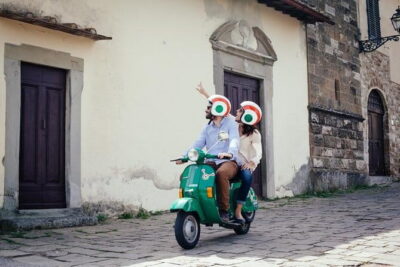
Florence Vespa Tour: Tuscan Hills and Italian Cuisine
Read our review →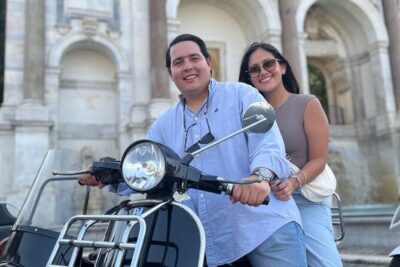
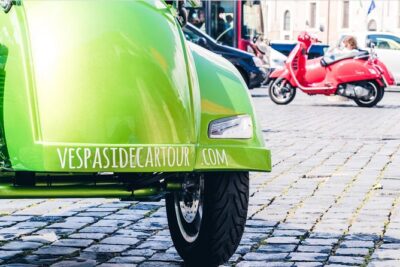
Rome Morning Vespa Sidecar Tour in Rome with Cappuccino
Read our review →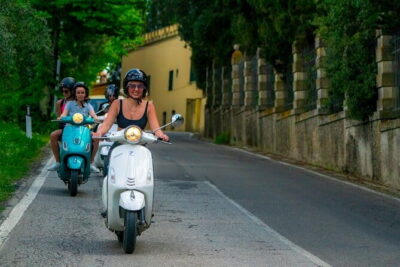
Chianti Vespa Tour with Lunch from Florence & E-car Option
Read our review →
Explore the City by Vespa with an Optional Photoshoot
Read our review →
Rome Vespa Scooter Tour with Professional Photographer
Read our review →
Highlights Vespa Sidecar Tour with Coffee and Gelato
Read our review →
Browse the lists this tour appears in