
Review · VESPA SIDECAR TOURS
Vespa Sidecar Tour In Rome with Pickup, Drop-off, Gelato included
Rome is made for a moving tour, and this one gives you a cheerful way to cover a lot of ground without wrestling with buses or Rome’s uneven pavement. You ride in a Vespa sidecar, pause at major sights, and get out for photos and short walks. Guides such as Enes, Aybars, Arda, Salman, and Ahmad have earned special praise for clear stories, safe driving, and a good sense of humor.
I like the hotel pickup and drop-off, especially if you are arriving tired or traveling with children or an older family member. I also like the small-group format, with no more than 14 people, plus gelato at the end. The main trade-off is time: roughly 15 minutes at each listed stop is enough for photos and a quick look, but not for full visits to the Colosseum, Pantheon, or Castel Sant’Angelo.
Key points to know before booking
- Seven major Rome stops in about three hours: You see the Colosseum, Spanish Steps, Castel Sant’Angelo, St. Peter’s Square, Fontana dell’Acqua Paola, Pantheon, and Piazza Venezia.
- Each Vespa sidecar carries two people: You receive one sidecar for every two passengers, with a maximum group size of 14.
- Hotel pickup saves time: The driver arrives at the pickup point 10 minutes before the time on your booking.
- Guides do more than drive: Enes, Aybars, Arda, Salman, Ahmad, and other guides are praised for clear explanations, photos, and careful service.
- Gelato is included: The tour ends with gelato at a respected gelateria in Rome.
- The Colosseum ticket costs extra: This is a sightseeing stop, not a full Colosseum entry tour.
Why a Vespa sidecar works so well in Rome
Rome’s famous sights are spread across the city. Walking between them takes time, and public transport does not always put you where you want to be. A Vespa lets you move through narrow streets and busy parts of town while keeping the ride social and open to the city around you.
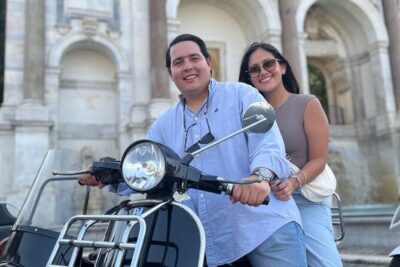
You sit in the sidecar or behind the driver, depending on the arrangement. Each sidecar is designed for two passengers, and helmets and hairnets are provided. The operator sets a maximum weight of 100 kilograms, or 220 pounds, per person, and a maximum height of 195 centimeters, or about 6 feet 5 inches.
This is not a driving lesson. You are a passenger while a trained driver handles the traffic. That matters in Rome, where the fun comes from seeing the city rather than worrying about directions.
The small-group setup also keeps the outing more personal than a large coach tour. The stated maximum is 14 people, though the number of Vespas depends on the group. A party of four, for example, receives two sidecars.
More Vespa Tours in Italy
- Vespa Sidecar Tour By Night with Pickup
★ 5.0 · 1,803 reviews - Rome Morning Vespa Sidecar Tour in Rome with Cappuccino
★ 5.0 · 1,771 reviews - Rome: Explore the City by Vespa with an Optional Photoshoot
★ 5.0 · 1,103 reviews
Colosseum photo stop, ancient Rome in one powerful view
The tour’s first major stop is the Colosseum, Rome’s most recognizable ancient building. You get about 15 minutes here, enough to step out, take photographs, and hear the story of the amphitheater, which opened in AD 80.
The value of this stop is the approach and the setting. From the Vespa, you get a sense of how the Colosseum sits within Rome’s older center. On foot, you can take in the great arches and the scale of the structure before the group moves on.
Keep your expectations clear. Admission to the Colosseum is not included, so you should not book this ride as a substitute for an interior visit. If you want to see the arena and underground areas, arrange a separate timed ticket. This Vespa tour gives you a city overview and a useful outside look.
Spanish Steps and Rome’s postcard views
At the Spanish Steps, the group stops near the top for about 15 minutes. The staircase links Piazza di Spagna with the church of Trinità dei Monti, and the upper viewpoint gives you a broad view down toward the square.
This is a good place for photos, but it is not a long stop. You can look over the streets, see the domes and rooftops, and get a quick sense of the area’s shopping and café scene. The stop works best as part of the larger route rather than as a full visit to the neighborhood.
The guide can add context about the staircase and the surrounding streets, while you get a break from the sidecar. If you have already seen the Spanish Steps on foot, this stop is still useful because it gives you a higher angle and keeps the tour moving.
Castel Sant’Angelo beside the Tiber
Castel Sant’Angelo began as Emperor Hadrian’s mausoleum in AD 139. Over the centuries, it became a fortress, papal residence, and military stronghold. Its round shape and position near the Tiber make it one of Rome’s most striking buildings.
You have about 15 minutes here for photos and an explanation of its changing roles. The stop also brings you close to views toward the Vatican and the river.
The description of the stop refers to the castle’s corridors, courtyards, and upper views, but the tour information does not list an admission charge or a full interior visit. Treat this primarily as a sightseeing and photo stop unless your guide tells you otherwise. A separate ticket would be needed for a proper visit inside.
More Vespa Tours in Rome
- Rome Vespa Scooter Tour with Professional Photographer
★ 5.0 · 857 reviews - Rome: Highlights Vespa Sidecar Tour with Coffee and Gelato
★ 4.9 · 747 reviews - Rome: Vespa Ride with Pictures and Sweet Tastings
★ 5.0 · 723 reviews - Rome Afternoon Sightseeing Vespa Sidecar Tour with Gourmet Gelato
★ 5.0 · 692 reviews
St. Peter’s Square and the Vatican view
The stop at St. Peter’s Square gives you a look at the center of Vatican City. You can see the broad colonnades, the facade of St. Peter’s Basilica, and the famous dome that dominates this part of Rome.
You have roughly 15 minutes here. That is enough to take in the square, photograph the basilica, and hear about the Vatican’s religious and artistic importance. It is not enough time to visit St. Peter’s Basilica, the Vatican Museums, or the Sistine Chapel.
That short visit is still useful because Vatican City can feel confusing on a first trip. Your guide helps place the square within Rome’s wider story. If the Vatican is a priority, plan a separate visit with timed entry. Use the Vespa stop as an introduction, not as your full Vatican day.
Janiculum Hill and Fontana dell’Acqua Paola
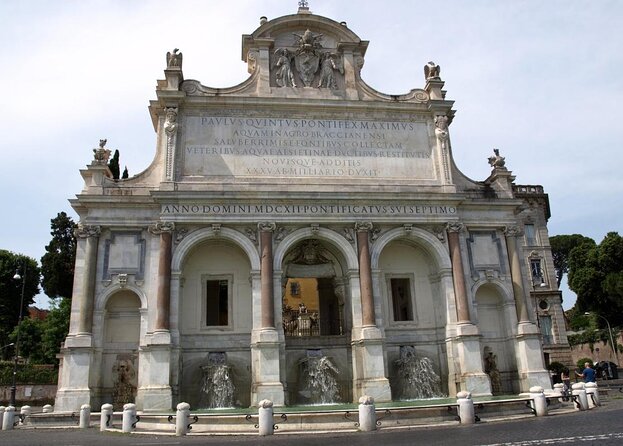
Fontana dell’Acqua Paola is one of the tour’s more unusual stops. It sits on Janiculum Hill, above much of central Rome, and marks the restoration of the Aqua Traiana aqueduct in the early 17th century.
The fountain itself is impressive, but the real prize is the view over Rome. After several central stops, this hill gives you space and distance. You can look across the city while the guide explains how the aqueduct supplied water and why the fountain was built.
You get about 15 minutes here. I consider this stop particularly valuable because it adds something beyond the standard Rome checklist. The Colosseum and Pantheon are essential, but Janiculum Hill offers a different sense of the city’s shape and setting.
Pantheon, where ancient engineering still feels modern
The Pantheon is one of the tour’s most important stops. Emperor Hadrian rebuilt the structure around the second century AD, and its enormous concrete dome remains the star of the show. The central oculus opens to the sky and gives the interior its unusual light.
The tour description presents this as an opportunity to step inside and hear how the building changed from pagan temple to Christian church. At the same time, the overall stop is listed as about 15 minutes, so the visit will be brief if interior access is available.
Check your timing and the conditions on the day. The tour includes no separate Pantheon admission charge in the information provided, but short stops can change with crowd control and access rules. Either way, you get a close look at one of Rome’s finest surviving ancient buildings.
Piazza Venezia and the Vittoriano
Piazza Venezia is a major traffic and civic hub in central Rome. The stop focuses on the square and the Vittoriano, the large white monument associated with modern Italian national history.
This is a quick 15-minute pause, useful for photographs and orientation. The square connects several important parts of Rome, and your guide can explain why it has long been linked with political power and public life.
Do not expect a quiet piazza. This is one of the city’s active road junctions, and the stop is more about seeing the monument and understanding its position than sitting in a peaceful square. It gives the route a modern historical chapter after the ancient sites.
The guides make the difference
The drivers are also guides, and this is where the tour earns much of its appeal. Enes is praised for adjusting the route when passengers had already visited the Colosseum, while also returning a wallet left in the sidecar. Aybars is singled out for clear explanations, patience, and friendly service.
Arda, Salman, Ahmad, Yaman, Adam, Yunus, Mustapha, Alessandra, Gianni, Beyza, and others are also named in the feedback. The repeated themes are careful driving, useful stories, help getting into and out of the sidecar, and an eye for good photographs.
That last point matters. A Vespa tour is partly a sightseeing trip and partly a photo outing. Guides may take pictures for you at the stops, and several passengers especially valued getting strong images without having to ask strangers to take them.
You will still want to speak up about what interests you. If you care more about architecture than shopping, or want extra time at a particular site, tell the guide early. One advantage of a small group is that the route can sometimes be adjusted, especially when the group is very small.
Families, older passengers, and solo visitors
The tour suits families well. Children aged nine, 11, and 12 are specifically noted in the supplied experiences, and parents valued the fun ride, short stops, photos, and gelato. One family even encountered rain and received ponchos from the drivers.
Older passengers can also enjoy it, but the sidecar arrangement deserves attention. One pair of passengers in their seventies found the sidecar comfortable, while the seat behind the driver was bumpier on uneven Roman pavement. If you have back, balance, or mobility concerns, ask the operator about seating before booking.
Solo visitors can book too. You would still ride as a passenger, and the experience provides a social way to see the city without joining a large bus. A solo booking may affect how the sidecar seating is arranged, so confirm the details if that matters to you.
The ride has also worked well as an evening outing. Night departures can show Rome’s monuments under lights and bring cooler air, though the supplied schedule does not promise a particular departure time. Choose the time that fits your plans and the weather.
Price, timing, and what the $143.91 covers
At $143.91 per person, this is not Rome’s cheapest sightseeing option. You are paying for a three-hour private-style ride, a driver-guide, hotel pickup and drop-off, helmets, hairnets, insurance, and gelato.
The value depends on what you want. If you prefer museums, long interior visits, and detailed archaeology, spend this money on entry tickets and a walking guide. If you want to see many parts of Rome in a short stay, the price becomes easier to justify. You cover the Colosseum, Spanish Steps, Vatican area, Pantheon, Piazza Venezia, and Janiculum Hill without arranging transport between them.
The tour is especially useful if you have only a day or two in Rome. It gives you a quick map of the city and helps you decide where to return on foot. It is less useful if your main goal is to spend hours inside each monument.
Pickup and drop-off remove another practical cost: time spent getting to a meeting point. The driver arrives 10 minutes before the scheduled pickup time. Make sure your hotel or pickup address is accurate when booking.
Free cancellation is available up to 24 hours before the start time for a full refund. Changes or cancellations inside that 24-hour window are not accepted for a refund.
What to pack and how to prepare
Wear clothes that work for sitting on a moving vehicle and walking around historic sites. Comfortable shoes matter because you get out at every stop. Bring sunglasses and a light layer, since the ride is open to the air.
Rain is possible, and the drivers have provided ponchos during wet outings. Still, check the forecast and dress sensibly. Your phone or camera should be easy to reach, but keep a secure grip when the Vespa is moving.
The operator provides helmets and hairnets. You do not need to bring riding gear. Keep your belongings compact because sidecar space is limited.
The tour is offered in English. Most people can participate, but the weight and height limits apply to every passenger. Ask about seating in advance if you need help climbing into the sidecar or have concerns about the ride over uneven streets.
Should you book this Vespa tour?
Book it if you want a fast, cheerful introduction to Rome, especially during a short stay. Families, solo visitors, older passengers who are comfortable with a vehicle ride, and anyone who enjoys photography will get the most from it.
I would also choose it early in a Rome visit. The route shows you where the main sights sit, and the guide’s stories can help you plan the rest of your days. Enes, Aybars, Arda, Salman, and the other named guides have made a strong impression through safe driving, good explanations, and personal attention.
Skip it if you want extended time inside the Colosseum, Pantheon, Vatican Museums, or Castel Sant’Angelo. The stops are short, the Colosseum ticket is not included, and Rome’s old streets can make the ride bumpy.
For the right kind of visitor, though, the sidecar is the point. You see Rome at street level, cover a surprising amount of ground, stop for photographs, and finish with gelato. That is a practical and memorable way to get your bearings before settling into a longer Roman stay.
FAQ
How long is the Vespa sidecar tour?
The tour lasts approximately three hours.
What sights are included?
The route includes the Colosseum, Spanish Steps, Castel Sant’Angelo, St. Peter’s Square, Fontana dell’Acqua Paola, the Pantheon, and Piazza Venezia.
Is hotel pickup included?
Yes. Pickup and drop-off are offered. The driver arrives at the pickup point 10 minutes before the time shown in your booking.
Is Colosseum admission included?
No. Admission to the Colosseum is not included in the tour price.
How many people ride in each Vespa sidecar?
Each sidecar carries two passengers. You receive one sidecar for every two people in your group.
What is the maximum group size?
The tour has a maximum of 14 participants.
Are helmets and hairnets provided?
Yes. Helmets and hairnets are included, along with insurance and drivers for each Vespa sidecar.
Is gelato included?
Yes. Gelato at one of Rome’s best gelato shops is included.
More Vespa Sidecar Tours in Rome
- Rome Vespa Sidecar Tour: 90-Minute Panoramic Experience
★ 5.0 · 239 reviews - Vespa Sidecar Tour at Day/Night with Pickup
★ 5.0 · 217 reviews - Vespa Sidecar Tour: Express Highlights of Rome
★ 4.8 · 172 reviews - Rome 3-Hour Evening Vespa Sidecar Tour with Gourmet Pizza Tasting
★ 5.0 · 106 reviews
Newly added around Rome
- Vespa tour with Professional Photoshoot★ 4.8 · 22 reviews
- Vespa Voyage: Scenic Routes of Rome★ 5.0 · 41 reviews
- Vespa – Wine and Photography service in Rome★ 5.0 · 32 reviews
- Rome: Vespa Tour with Gelato and Photos★ 4.9 · 7 reviews
- Vespa Tour with Professional Photographer★ 4.9 · 9 reviews
- Vespa Tour – Explore Ancient Rome★ 5.0 · 5 reviews
- Food tour & Vespa tour & Photo tour! All included★ 5.0 · 2 reviews
- Vespa scooter tour in Rome with Pro-Photographer★ 4.9 · 21 reviews
Vespa Sidecar Tours, compared.
Rome Morning Vespa Sidecar Tour in Rome with Cappuccino
Read our review →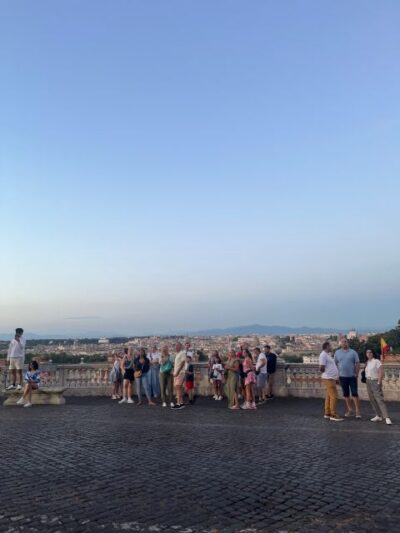
Highlights Vespa Sidecar Tour with Coffee and Gelato
Read our review →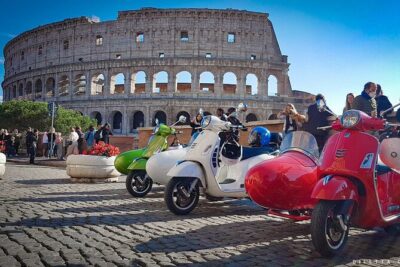
Rome Afternoon Sightseeing Vespa Sidecar Tour with Gourmet Gelato
Read our review →
Rome Vespa Sidecar Tour: 90-Minute Panoramic Experience
Read our review →
Rome 3-Hour Evening Vespa Sidecar Tour with Gourmet Pizza Tasting
Read our review →Browse the lists this tour appears in