

Review · NIGHT SCOOTER TOURS
Athens by Night Electric ATV Scooter Tour
Athens by night has a special advantage: the harsh daytime sun fades, the old stones glow, and the city’s many eras begin to make sense. On this three-hour ride, you roll from Plaka past the Acropolis, ancient theaters, democratic meeting grounds, Roman monuments, and the marble Panathenaic Stadium on a small electric ATV scooter.
I like the small group limit of 10, which keeps the ride more personal and makes stops easier. I also like the way the route links famous sights with less obvious places such as the Hill of Pnyx and Areopagus. The main consideration is that you are riding through a historic city, not taking a quiet sightseeing bus tour, so you should feel comfortable handling a four-wheel scooter and sharing the road.
- Night views of the Acropolis: See Athens’ most famous monument after sunset, with time for photographs near the Odeon of Herodes Atticus.
- A route through three thousand years: The ride connects ancient Athens, Roman rule, modern Greece, and the first modern Olympic Games.
- Small electric ATV scooters: You get a quieter, cleaner way to move between sights, without the effort of walking the whole route.
- The birthplace of democracy: Stop at the Pnyx, where ancient citizens gathered for political decisions.
- Patient personal guidance: Guide Stelios is noted for helping first-time riders get used to the four-wheel scooter.
- A practical city introduction: The route can help you understand Athens’ layout early in your stay.
Why Athens Works So Well After Dark

Athens is easier to appreciate when you are not rushing from one hot archaeological site to the next. At night, the Acropolis rises above the city with fewer visual distractions, while Plaka’s narrow lanes take on a more relaxed feel.
The electric ATV scooter gives you a middle ground between walking and a vehicle tour. You cover too much ground for a normal stroll, but you still stop often enough to look around and hear the guide. The scooter is small, so it suits a city route better than a large motor vehicle.
This is not a speed-focused activity. The point is to move through central Athens at a useful pace, stopping at places that explain how the city developed. You will see ancient civic spaces, Roman monuments, royal-era buildings, and modern Greek institutions in one continuous outing.
The tour costs $100 per person. That is not a bargain for a three-hour activity, especially since food, drinks, hotel transfers, and entrance tickets are not included. The value comes from the combination of transport, a live English-speaking guide, insurance, and access to many viewpoints in a short period.
If you already plan to walk through central Athens on your own, you may prefer to spend that money on museum admission or a longer meal. If you want a guided orientation and do not fancy covering the same distance on foot, the price becomes easier to justify.
Starting in Plaka, Athens’ Oldest Neighborhood
The ride begins in Plaka, the old neighborhood beneath the Acropolis. This is a fitting starting point because the area gives you an immediate sense of Athens as both an ancient city and a modern destination.
You can expect narrow streets, traditional Greek character, and a close view of the Acropolis rising above the rooftops. Starting here also makes practical sense. Plaka places you near several of the evening’s main stops, so the route can move quickly into the archaeological core.
The first few minutes matter if this is your first time on a four-wheel scooter. Guide Stelios has been specifically noted for being patient while riders learn how the vehicle handles. That is useful because a small ATV scooter is different from a bicycle, motorcycle, or standard electric scooter.
Take your time at the beginning. Make sure you understand the controls, turning radius, braking, and the guide’s riding instructions before the group moves off. Helmets are listed as optional, but I would ask about one and wear it if available and suitable for you.
More Night Scooter Tours in Athens:
- Vespa Sidecar Tour By Night with Pickup
★ 5.0 · 1,803 reviews - Saigon Evening Food Tour by Scooter
★ 5.0 · 944 reviews - Bangkok: E-Scooter Night Tour with Local Street Food
★ 4.8 · 488 reviews
The Acropolis and the Odeon of Herodes Atticus
The route first takes you alongside the Acropolis. You will not be paying an entrance fee or touring the interior of the archaeological site, but you will get views of the hill and its monuments from the surrounding streets.
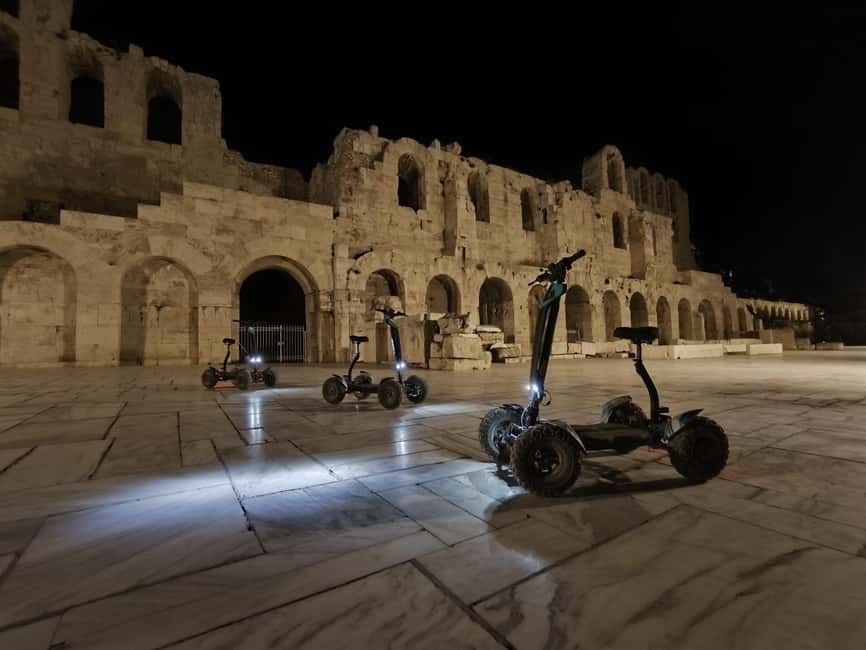
The first major stop is the Odeon of Herodes Atticus, a stone theater built in the Roman period. It remains one of Athens’ most striking performance spaces, with its curved seating and tall stone wall set below the Acropolis.
At night, the setting can feel more dramatic than it does under the bright midday sun. This is one of the better places to pause for photographs, though you should listen carefully to the guide’s explanation rather than treating it only as a photo stop.
A key point is that this tour offers outside views and historical context, not entry into the Acropolis or Odeon. Entrance fees are not included, so plan a separate visit if you want to see the interiors or climb the Acropolis itself.
Areopagus and Pnyx, Two Hills With Big Ideas

The ride then reaches the Hill of Mars, also called Areopagus. In ancient Athens, this rocky hill was linked with judicial proceedings. From here, you get a useful view across the city toward the Acropolis and surrounding neighborhoods.
The viewpoint helps you understand Athens’ shape. Instead of seeing monuments as isolated stops on a map, you can see how the Acropolis, older civic areas, and modern streets fit together.
The surface and slope are worth keeping in mind. The route includes hills, and an ATV scooter can make the effort easier, but you still need to be steady and attentive. Comfortable shoes are a good idea, especially when you get off for short walks or viewpoints.
Next comes the Hill of Pnyx, one of the tour’s most meaningful stops. Ancient Athenian citizens gathered here to debate and make political decisions. The site connects a physical place with one of the ideas most often associated with Athens: direct participation in public life.
I like this part of the route because it gives the history a clear human scale. You are not just looking at columns. You are standing where people met, argued, voted, and shaped a new form of government.
Thissio and Keramikos, Beyond the Famous Monuments
The ride continues through Thissio, a central area known for its proximity to major ancient sites and its views toward the Acropolis. This is one of the sections where the scooter saves time. Walking between all the evening’s stops would take longer and leave less time for explanations.
Near Keramikos, you pass an archaeological area that served as both a cemetery and a place connected with pottery production. That combination offers a glimpse into everyday classical life. Ancient Athens was not only temples and public speeches. It also needed workshops, roads, burial grounds, and the ordinary work of making a city function.
The area may appeal to you if you prefer archaeology with a little context beyond the headline monuments. It also shows how the city’s boundaries and neighborhoods changed over time.
Do not expect a long, detailed archaeological-site visit here. The tour is designed as a moving overview, with selected stops and brief breaks. If Keramikos interests you greatly, you will want to return during opening hours for a separate visit.
More quad bike runs around Athens:
- Ancient Athens Electric ATV Scooter Tour
★ 4.9 · 29 reviews - Best of Athens Electric ATV Scooter Tour
★ 4.3 · 5 reviews - Modern Athens Electric ATV Scooter Tour
★ 5.0 · 4 reviews - Scooter rentals ,Atv rentals and Buggy Rental,Nassau Bahamas
★ 5.0 · 40 reviews
The Ancient Agora and Monastiraki After Sunset
The Ancient Agora was once the center of public life in Athens. It was a place for meetings, trade, political activity, and daily business. The stop helps explain how the city operated when the Acropolis was only one part of a much larger urban system.
This is another point where the guide’s role adds value. Without context, an ancient ruin can look like a collection of stones. With a clear explanation, you can picture the Agora as a working public center rather than a silent archaeological field.
The route then reaches Monastiraki Square. Here, ancient remains meet modern Athens. The square connects shopping streets, food spots, transportation routes, and major historic landmarks.
You will see a different side of the city from the quiet hills and archaeological areas. Monastiraki has more urban energy, and you should expect people, traffic, and activity around the square. That contrast is part of the appeal, but it also means you need to stay alert while riding.
Nearby are the Library of Hadrian and the Roman Agora. These sites show how Athens continued to matter after the classical period. Roman rulers added their own buildings and institutions, leaving the city with several layers rather than one neatly defined historical era.
Syntagma Square and the Changing of the Guards
The ride returns through Plaka before reaching Syntagma Square, the political center of modern Greece. The Hellenic Parliament faces the square, linking the current state with the older civic traditions seen earlier in the route.
A planned stop here includes the changing of the guards. This ceremonial tradition is one of the most recognizable sights in modern Athens. The uniforms, formal movements, and setting outside Parliament make it a memorable pause, especially if this is your first visit to Greece.
The timing of the ceremony can matter, and the exact experience may depend on when your tour begins. The activity description includes witnessing the changing of the guards, but it does not promise a particular ceremony schedule. Ask the provider about the departure time if this is a top priority for you.
The route continues past the National Gardens and Zappeio Mansion. These stops add a more formal, nineteenth-century side of Athens, away from the tight lanes of Plaka and the exposed ruins of the ancient center.
The Panathenaic Stadium in Marble
The Panathenaic Stadium is one of the tour’s strongest visual stops. It is built entirely of marble and hosted the first modern Olympic Games in 1896.
The stadium’s shape is easy to recognize, but the material makes it unusual. The pale marble catches evening light and gives the site a clean, almost sculpted appearance. It also helps connect ancient athletic traditions with the modern Olympic movement.
As with the other landmarks, the tour provides an exterior visit and historical explanation rather than an included admission. If you want to enter, walk through the seating areas, or see the track from inside, you will need to pay separately.
The stadium works especially well near the end of the route because it gathers several themes from the evening: ancient culture, modern national identity, architecture, and public ceremony.
Hadrian’s Arch and the Temple of Olympian Zeus
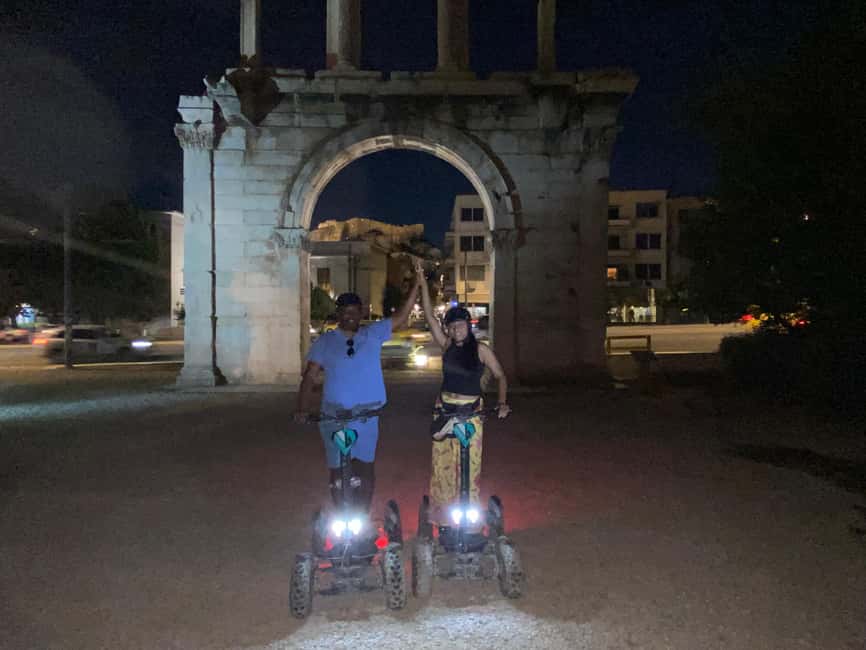
The final historical stops include Hadrian’s Arch and the Temple of Olympian Zeus. Hadrian’s Arch marks the Roman influence on Athens, while the temple represents the huge scale of ancient religious construction.
The Temple of Olympian Zeus was built on a grand scale, and even an outside view gives you a sense of its size. The remaining columns are widely spaced, so you can understand how large the completed complex must have been.
These monuments provide a useful final chapter. You begin with the Acropolis and classical Athens, pass through civic spaces and Roman additions, and finish with a reminder that Athens continued to change under later rulers.
The route then returns through Plaka, bringing you back to the neighborhood where the evening began. You will have covered a broad section of central Athens without spending the entire night walking between landmarks.
What the Three Hours Feel Like
The tour includes stops for history, photographs, city views, rest, and hydration. It is not three continuous hours on the scooter, which makes the pace easier to manage.
Still, you should dress for the weather. Bring comfortable shoes, a small bottle of water, a hat, sunscreen, and lightweight sunglasses in hot weather. In cooler seasons, add a layer and consider gloves and a scarf. If rain threatens, the provider can supply a plastic poncho.
The electric scooter is an important part of the experience, but it also creates the main physical requirement. You need to control a small four-wheel vehicle and remain alert around city streets. The tour is not suitable for children under nine.
The group size is limited to 10 participants. That is small enough for the guide to watch the group and answer questions without the feel of a large convoy. It also means the experience may sell out more quickly than a standard walking tour.
Insurance is included. Hotel pickup and drop-off are not, so you need to reach the starting point in Plaka on your own.
Who Will Get the Most From This Ride
I would recommend this tour if you want a fast but thoughtful introduction to central Athens. It is especially useful early in your stay because the route gives you a mental map of the city. Once you know where the Acropolis, Agora, Syntagma, stadium, and Roman monuments sit, later walks become easier to plan.
It also suits older travelers who want to see a lot without walking every kilometer. The experience is not entirely effortless, since you still mount, steer, stop, and walk at several points, but the scooter reduces the distance between major sights.
You should think twice if you dislike city riding, want a slow archaeological tour, or plan to enter the major sites. This activity is an overview from the streets, not a replacement for a full Acropolis, Agora, or stadium visit.
Families should note the minimum age of nine. The tour is in English, and the small group format makes it a good fit for visitors who want questions answered along the way.
Is the $100 Price Worth It?
At $100 per person, the cost is reasonable only if you value the transport and guided orientation. You are not paying for admission to the Acropolis, Ancient Agora, Keramikos, Panathenaic Stadium, or other archaeological sites. You also pay separately for food, drinks, and transportation to the meeting point.
The stronger value is the number of places covered in three hours. A self-guided walk could be cheaper, but it would require more route planning and likely less historical explanation. A walking tour could also cost less, but it would not cover the same distance as easily.
Free cancellation up to 24 hours before departure and the option to reserve now and pay later add useful flexibility. Check the available starting times, especially if seeing the guards at Syntagma is important to you.
Should You Book Athens by Night?
Book it if you want a well-paced first look at Athens, enjoy unusual transport, and like combining major landmarks with places tied to democracy and civic life. The nighttime setting, small group, and patient instruction from Stelios make the experience especially appealing to first-time visitors and older riders who want help getting comfortable on the scooter.
Skip it if you prefer to spend your money on site admissions, need hotel transportation, or feel uneasy riding in an urban setting. For the right rider, this is a practical way to connect Athens’ ancient and modern sides in one evening, with enough stops to keep the history from becoming a blur.
FAQ
How long is the Athens by Night Electric ATV Scooter Tour?
The tour lasts three hours.
Where does the tour start?
The tour starts in the Plaka neighborhood of Athens.
What language is the tour in?
The live tour guide speaks English.
How many people are in the group?
The group is limited to 10 participants.
What landmarks does the tour visit?
The route includes the Acropolis area, Odeon of Herodes Atticus, Areopagus, Pnyx, Thissio, Keramikos, Ancient Agora, Monastiraki Square, Library of Hadrian, Roman Agora, Syntagma Square, the Hellenic Parliament, National Gardens, Zappeio Mansion, Panathenaic Stadium, Hadrian’s Arch, and the Temple of Olympian Zeus.
Are entrance fees included?
No. Entrance fees are not included in the tour price.
Is hotel pickup included?
No. Hotel pickup and drop-off are not included.
What is included in the tour price?
The price includes a tour leader, a small ATV, helmets listed as optional, and insurance.
How old must children be to join?
Children under nine years old cannot join the tour.
Newly added around Athens
- 10 Days Tour Walk Athens Cycle Peloponnese Scooter Santorini★ 5.0 · 4 reviews
- GoPro Adventure Tour in Acropolis area by E-Scooter★ 4.5 · 8 reviews
- Modern Athens Electric ATV Scooter Tour★ 5.0 · 4 reviews
- GoPro Adventure Tour in Acropolis area by E-Scooter★ 4.9 · 19 reviews
- Best of Athens Electric ATV Scooter Tour★ 4.3 · 5 reviews
- Athens: Guided City Tour on an Electric Trikke Scooter★ 4.4 · 7 reviews
- Ancient Athens Electric ATV Scooter Tour★ 4.9 · 29 reviews
- Athens: Premium Guided E-Scooter Tour in Acropolis Area★ 5.0 · 133 reviews
Night Scooter Tours, compared.




Siem Reap Evening Foodie Vespa Tour / Tuk Tuk Available
Read our review →
Saigon After Dark Vespa Street Food Tour + Live Music 4 hours
Read our review →
Small-Group Night Tour in Budapest on MonsteRoller e-Scooters
Read our review →
Rome 3-Hour Evening Vespa Sidecar Tour with Gourmet Pizza Tasting
Read our review →Browse the lists this tour appears in